Showing posts with label homeschooling. Show all posts

Wednesday, September 22

Homeschooling History

My girls are both using Catholic Heritage Curricula this year, and I really like their history programs. Each are writing summaries of the things they are learning about, and they are both researching in the library and in our nifty new encyclopedia set. (I bought the 2000 edition of the World Book Encyclopedia, minus a couple of books, for $5 at our local branch.) Between the World Book and Maureen Wittmann's resource, I'm doing well in getting books for them to read.
*********************
In the first quarter of fourth grade, Little Girl is researching our home state of Virginia. Each week she writes a little more about the state. So far, she's done three essays on the things she's learned. I have helped a bit with structure, and this week I helped a bit with sorting out the precious little (and slightly confusing) information we could find about early missionaries in Virginia. But by and large, she has written these essays on her own. She's occasionally asked for help in creating a decent sentence out of her new knowledge, and I have, naturally, made some corrections. These are all normal for her age. (Any notes within their essays, I have included as smaller text in italics.)

Here are her three essays that she's done so far on Virginia:

I. Virginia

The first people that lived in Virginia lived here in the fifteen-thousand BC, they lived here till the beginning of the sexteen-hundreds. At least, that's what the scientists say, they actually could have lived here longer, or shorter. By about 1200 BC the woodland culture began. Now, a chief or head-man would lead a village. ARound that time they learned to dig up clay from the wet riverbank to make what archaeologists call woodland pottery. Later on, people from England came to Virginia and made a settlement called Jamestown.

In his early tweties, John Smith traveled all over the middle east and Europe. He sailed across the Atliantic Ocean and ended upin Virginia. He named the town he found Jamestown. When more people, later on, lived in Jamestown, there was more farming done. But, the farmers did not do the sowing, the watering, the weeding, or any other important gardening things. They had slaves that did the work for them instead of doing the work themselves. The people that lived in Virginia had slaves for a long time, until Abraham Lincoln made a new law that made slavery illegal. Virginia has a nickname, like other states, and Virginia's nickname is "The Old Dominion." It was made a state in 1776, and the state flower is the Dogwood. The state tree is the flowering dogwood.

(You can see here that I didn't do a lot of correcting and adjusting. I wanted her to feel good about finishing her first really big research project. We talked about ways to improve it the next time, but I mostly left this one alone.)


II. Virginia Part II (How Virginia Became a State)

Before Virginia became a state, the British ruled the thirteen colonies. A group of people gathered together and discussed independence because they did not like being ruled by a king. Some of the people were Benjamin Franklin, Thomas Jefferson, and John Adams. The committee wanted someone to write a Declaration of Independence. Thomas Jefferson was the one instructed to write it. He began his work on June 11th 1776. After finishing his final draft, the other people in the committee edited it and gave it to congress on June 28th. On July 2nd, congress voted for independence before releasing it to the public on July 4th, or, Independence Day.

In 1882, John Adams wrote a letter to Timothy Pickering that, at the beginning, read:
"You inquire why so young a man as Jefferson was placed at the head of the committee for preparing a declaration of independence? I answer: It was the frankfort advice to place Virginia at the head of everything."

III. Taking a Look at Virginia's Early Missionaries (You see here that her title has even improved! I didn't even mention this to her, but she might have picked it up from my lessons with her sister.)

In 1526, Dominican friar Antonio de Montesinos said mass near the future Jamestown. Friar Antonio also brought back Indians to Spain. One of the Indians was later baptized as Don Luis de Velasco. Later, in 1570, Don Luis de Velasco helped two priest and their companions on a mission to Axacon. The priests were named Fr. Segura and Fr. Luis de Quiro. Their trip was not just them but seven other Jesuits and three Indian boys. That means there were thirteen all together on the mission. The priests and their companions landed and fortunately got a warm welcome. They later built a log chapel and started a mission with the help of Don Luis. Unfortunately, Don Luis betrayed them and helped the nearby Indians kill everyone in the mission but one Indian boy. After that, missions stopped until Virginia became a colony. Maryland was a colony at the same time as Virginia, but it was especially for Catholics. People in Maryland supported new missions in Virginia, because it wasn't a good place for Catholics until 1786, when Thomas Jefferson wrote a statues allowing Catholics to be free in worship. Many years later, on July eleventh, 1820, Pope Pius VII created the Richmond Diocese.

(I admit that I think I corrected, while typing, a couple of spelling errors. I think she wrote "compainions" and "fortunally" in there. But she did spell out the numbers as I typed them!)

The next set of writing she'll do is about the states Catholic shrines and/or missions. Might be interesting since our parish itself was a mission parish at one point! In fact, because Catholics comprise such a small part of the population in Virginia, this is actually still considered mission territory! What will also be nice is that in October we'll be at the Basilica of the Shrine of the Immaculate Conception in Washington, D.C.

*********************
Big Girl has a different task this year. Though she, too, is studying American history, hers is much more in depth - as it should be for a seventh grader! Every week she has a new set of topics to research, and she writes not only a summary of the topic, but she also writes shorter essays on sub-topics that relate to the main one!

Her first week was about Indians in North America. She read in Christ and the Americas about the Aztecs and wanted to learn more about them. Here are her three essays from the first week of history:

The Aztecs

The Aztecs were an interesting culture. They had different habits than we do now. The women stayed home and cleaned, while the men gathered the crops, or worked in the fields. Women's clothes were a sleeveless blouse, with a skirt, while men wore only a loincloth & a tilma.

In battle, the Aztecs fought to capture, not to kill. While fighting Aztecs would only midly wound their enemy, then take them as prisoners. Later, they would sacrifice the prisoners.

As for religion, the Aztecs were very gory, because they would cut the heart out of a living man, then throw the body in a ditch. There were many Aztec gods, mostly gods of harvest & of plants. They made sacrifices almost every day.

Mostly, the Aztecs ate tortillas with vegetables. However, they also ate mean, and drand chocolate drinks. They also raised dogs & turkeys for food.

So, the Aztecs were different, but not all in a bad way. To them, we would be weird, too. After the Spanish Conquest, the Aztecs died out. However, we know they were an interesting race, and that they were brave & strong.

The Aztec Gods


The Aztecs thought highly of their gods. There were sacrifices almost every day. Over 100 people died each sacrifice. This cut down the population greatly. The Aztecs thought if they didn't sacrifice, the sun wouldn't rise the next day. There were many gods, many of which had to do with nature. The gods were worshipped until Cortez arrived. The Aztecs built HUGE stone monuments to the gods the size of cathedrals! Once a sacrifice took place for 4 days and 4 nights! 80,000 men died that night. The priests would cut out a victim's hear, place the heart in a statue of a god's mouth, and throw the body in a ditch.

Hernando Cortes

Hernando Cortes was sailing to mexico. When he got there, he found the Aztec Civilization. The emperor, Montezuma II, feared he was a god, &, having had a bad treatment in the past, came back to avenge himself. The year was 1519. Cortes had actually come for wealth and riches. Though he arrived on Good Friday, he was battling the Aztecs by the end of the year. The Aztecs, after they found out he wasn't a god, were angered because he wouldn't leave.

The first battle raged, then both sides, Spaniards and Aztecs backed away. The fights continued for over a year, until the Spaniards prevailed. But it still took a lot to win. Cortes even took Montezuma II hostage for a time. Later, however, Montezuma II died of battle wounds. So in Tenochtitlan, future Mexico City, the Spaniards defeated the Aztecs. He ended the brutal sacrifices. And, he is now remembered throughout history.

The second week brought us to the Vikings: first explorers of the New World. Notice how she has gotten the hang of grabbing your attention with a title and the opening lines.

Let's Go A-Viking!

Vikings were not like Haagar the Horrible. Nor were they like the Minnesota Vikings. Many of the presumptions we have about Vikings are incorrect. First of all, they did not have horns on their helmets. And, though barbaric at times, the Vikings had a softer side: family life.

The Vikings usually had arranged marriages, but women had more rights than women of other cultures at the time. They had a right to money, land, and could divorce their husband whenever they wanted.

The main occupation of a Viking was farming. They grew barley, oats, rye, fruits and vegetables. They raised cattle, goats, pigs, sheep, and were even fishermen!

For recreation, they liked rowing, swimming, skiing, wrestling, and horse races.

The Vikings liked poetry, so that's why we have sagas. They also painted and crafted boats.

As for religion, Vikings were polytheists, but there were 3 main gods: Odin, king of the gods; Freya, goddess of agriculture; and Thor, god of war. The Vikings also had Valhalla, life after death, where you could fight all day and feast all night. Later, Lief Ericsson led them to start to convert to Christianity.

Vikings came from many places. They came from Sweden Denmark, and Norway. They Swedes invaded Western Russia, Eastern Belarus, and Eastern Ukraine. The Danish invaded France, the Netherlands, and parts of England. The Norwegians invaded England, Ireland, Scotland, the Isle of Man, and Lindisfarne. The Vikings also helped unify France and England.

The Vikings first used Latitude and Longitude, and also discovered Greenland and Vinland, now called North America.

In spite of what popular culture says, Vikings were not all about fighting. They cared about family and harvest too. People think all they did was pillage and burn villages, but the Vikings also wrote poetry, painted, and made ships, which they considered art. Even today, we use their invention, Latitude and Longitude.

Leif Ericsson

Leif Ericsson was a Viking. He was the son of Eric the Red, who found Greenland. Leif was born around the year 980, in Iceland. Around 985, Leif's family sailed to Greenland. Around 999, Leif went back to Iceland, then to Norway, where he became a Christian. Leif then traveled around his father's tribe, preaching Christianity. In the year 1000, Leif sailed to a land that another had seen while sailing around. When he got there, he built a house for each of his men, a shed for their ships, and cut logs to bring back to Greenland where wood was scarce. On the way back, he rescued 15 men, who, in thanks, gave Leif their cargo which made Leif rich.

Eric the Red

Eric the Red was the Viking who found Greenland. When he was 10, his father was outlawed for manslaughter. Eric moved with his father to Iceland from Norway. After his father died, Eric killed several people & was exiled for 3 years. He then found Greenland, & persuaded others to come to this new land with him. His son Leif, in later years, found Vinland. Eric, after a fall off his horse, feared bad luch & stayed in Greenland until his death around 1000.

This week's topic is being spread out. Since our family is taking a trip and we'll have two short weeks, I split her work between those two weeks. Our topic this week and next is the Spanish exploration of the New World, as well as saints like Blessed Juniperro Serra. Here is her essay on the book she read about Ponce de Leon:

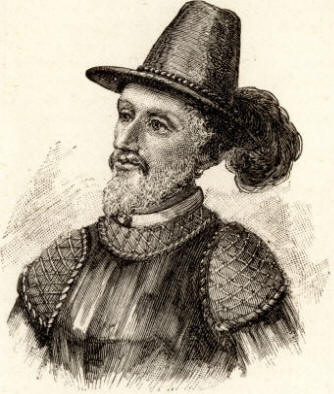
Ponce de Leon: The Man Who Found Florida

The year was 1513. Juan Ponce de Leon was on the deck of his ship when he heard a shout. "Tierra!" a sailor cried. "Land!" Juan looked and saw a thing, black line on the horizon.

Now, before you read more, here's some information on Ponce de Leon. He was a Spanish knight who fought the Moors. he went with Columbus on his 2nd journey to the New World. There, he fought Indians. Later, he went back and found a peninsula which he named la Florida, or the Land of Flowers.

Juan decided to tell King Ferdinand and Queen Isabel of this new land. After he told the king and queen, he went to Hispanola, where he was attacked by Indians. Wounded in battle, he retreated, but later died of his wounds. Juan inspired many others to explore Florida, including Panfilo de Narvaez and Hernando de Soto.

Juan Ponce de Leon will always be known as the man who found Florida.

§§§§§§§§§§§§§§§§§§§§§§§§§§§§§

You can see a definite progression here, I think. I'm so proud of how well both girls' writing is going, and I'm proud of how well they are dealing with all the research and reading that their history program is demanding this year!

I'll do my best to post more of their writing throughout the year.


Related:

Tuesday, September 21

Something to be Proud of

I've been asked a couple of times about why I insist on a Catholic curriculum, especially when it comes to history and science. Not often, but I was thinking about this recently.

The biggest reason I've stuck with Catholic-based history and science is because I want my girls to be proud of their Catholic heritage.

When I was in school - and it was public school - there was little discussion of the Catholic Church. But the few things that my history classes taught me about my Church in history included that we were the aggressors in the Crusades, Luther was heroic for standing up to a Church that sold indulgences (and let you buy your dead relatives out of Hell - I don't recall if Purgatory was mentioned), and the Catholic Church persecuted scientists like Galileo and Copernicus (and that the Church was and is, in general, anti-science).

When I started educating my girls, I wanted to have a Catholic perspective in education. I wanted them to have a Catholic school at home, basically. And it was then, reading their elementary school textbooks from Seton, that I learned the truth about many things I thought I knew from my public school history classes.


The Crusades were less about attacking Muslims than they were about helping pilgrims make safe journeys to and from the Holy Lands. And, incidentally, the Holy Lands were Catholic places before Mohammed came along and started terrorizing people. (Yes, I used that word. I mean it. Conversion by the sword has never been a part of Catholicism, but it is called for specifically in the Koran.)

Luther disregarded doctrines within the Catholic Church that he didn't like much, and his separation was not heroic. It tore the One, Holy, Catholic and Apostolic Church in half. The separation of the Orthodox Church was bad enough. But Luther was a monk! He broke his vows and lead people away from the Church. Indulgences were never sold (not by decree or permission from the Church, anyway; if it happened, it was done by rogue priests who were abusing their positions and vocations). And an indulgence isn't about "getting someone out of Hell." That's impossible. And purgatory is about as misunderstood as indulgences are. (For a good explanation of indulgences, I recommend Catholic Answers' site. Most Catholics couldn't explain them to you, which is why, when I mentioned to my father this tidbit of information, he couldn't explain why the description in my textbooks were wrong. So I offer two links: the first is a primer on indulgences, and the other debunks some of the myths about this ancient - and current! - practice of granting indulgences. Trust me, it's worth the read to have a better understanding of the idea.)

And the most surprising thing I've learned is that not only has the Church not persecuted scientists, but She's had quite a few in her own clergy! (Here is an excellent summary on Galileo, the ignorants' favorite example.) I didn't know until quite recently that Gregor Mendel was an Augustinian priest!

But my girls know these things. They're learning them as we learn about the famous people who make up our Western Civilization's history. They're learning that the first religious ceremony in what would become the United States was a Catholic Mass. They're learning that Florida, Mexico, South America, and the western areas of the United States were explored by Catholic nations and had countless missions dotting the wild frontier. They're learning that there were brave priests and sisters and brothers and nuns who came to this country to serve others and set up schools (long before the government was in the business of education) and offer hospital care and feed the poor.

What they're learning is what I did not learn until I was an adult.


To be Catholic is to have something to be proud of. Our Catholic heritage is rich. It's full of amazing people and wonderful discoveries and moving tales of charity and love and forgiveness. (Read some of the stories about the French Jesuits who were tortured by the Indians and begged to be sent back to be missionaries so they could save souls. Read about those who came after them and became martyrs, not because they were cruel or slave-masters, but because they would not abandon their Lord. And then read about the conversions that were made possible by tireless religious who risked their lives to share the Good News with those who had never heard it before!)

So what I am giving my children - what they gain from studying science and our history from a Catholic perspective - is something to be proud of. They'll hold their heads up when they say they're Catholic because they will have learned the truth:

The Catholic Church has done some pretty wonderful things. It's like a well-kept secret, but I'm determined to let that secret out!


Monday, August 9

Homeschooling and Organization

I used to be an organized homeschooler. I need the organization, but when I worked part-time from home while we worked on our debt snowball, I became a kind of molecular opposite of organized. Our school work started to suffer, and when it came to a breaking point, my husband and I made the decision that I'd quit. That was last year, and October 1 will be the anniversary of Mommy's Freedom Day; however, I never did get reorganized. I seemed to be in so many different places in the girls' school subjects that I made a hodge-podge of the end of the school year. There are subjects we just plain didn't finish. Others subjects became a "read-it-yourself" study.

So I'm a little trepidatious about the new school year. Little Girl will be in fourth grade, which is still not too bad as far as scheduling and work load, but Big Girl is starting seventh grade. Middle school is firmly underway. And I have to help her be ready for high school and beyond.

So I've spent the last few days working on her first quarter lesson plans, and I'm ever so glad I did it this early! She's got some heavy-looking research, a lot of writing, and a need of some science materials I wasn't expecting just yet. (A bunsen burner? A plate balance? Seriously??)

All day today, I've been touching up the girls' lesson plans and making copies of materials they'll need to use all year. I am determined to be better organized and to be a better teacher. My laziness as their teacher has helped make them lazy as students. And I'm not doing them any favors this way!!

Next for me will be looking for movies and books that will help them along. I've got a terrific book by Maureen Wittmann, For the Love of Literature, that will help me locate wonderful books to make the girls' learning more fun. If you're working on a literature-based education, this is a fantastic resource to have.

I made a few unexpected changes to our homeschool:

First, I changed Little Girl to Catholic Heritage Curricula. I'd read about it and thought it looked more appropriate for Big Girl, who is a very kinetic learner and needs to be able to make choices within some structure to feel good about school. I've often said that she is probably a prime candidate for a Montessori education, if only I weren't so completely not wired to provide it. (Seriously, I have a degree in education and was taught about the method and how to teach with it. I am not able to wrap my brain around it in any meaningful way.)

I was surprised at the accessibility of the books, and decided to use the same program with Little Girl starting now. We went over her school books today and talked a bit about how things will work, and we're both excited. Whereas Seton focuses very strongly on basic skills to achieve academic success, CHC works a little more organically. Seton is very workbook-intense, while CHC is more project-based. CHC probably leans a little more towards a Whole Language approach, but still has enough basic drills and memorization to make me feel confident that the girls are going to learn things in an organized manner.

Second, I have made a big change in religious education curricula. One of the subjects I've always loved from Seton has been their religious education. I still used it, even when I wasn't using anything else from Seton, for both girls - until this year. I knew I needed to get Big Girl out of the workbooks and into something different. So I decided I wanted to start her in the Faith and Life series this year. My plan was to leave Little Girl in the Seton books until seventh grade, as well. Until I got a good look at the books, that is.

Faith and Life, while still very careful to cover the faith in depth, has a wonderful layout and a flexible structure. It's designed for a classroom in a parochial school, but is easily adapted to home or even Sunday school classes. I am totally sold on it. I've made plans for all kinds of art projects for both girls that tie into the lessons. It's going to be great!

I'm adding something big for Big Girl this year.

We'll be reading Humanae Vitae together. Seriously. I'll let you know how it goes, but it makes me nervous.

The only thing that hasn't gone to the CHC curriculum choices remains math. We're sticking with Math-U-See for as long as I can see right now. The hands-on has been good for both girls. My biggest regret is that we are really badly behind in Math. I have to make a commitment (and stick to it) to cover a lesson every week or so. I think we'll be on a better track with it, and I've got plans for giving them some activities to work on their math. There are a couple of apps on the iPod that I've downloaded for them, and they actually enjoy them! I'm sure I'll discover more as time goes on, but these were not too spendy and they've helped the girls shore up their basic facts knowledge.

So there we are, ready for school to start. Well, ready except for about 100 pages of copies I still need to make. Thank God Sam's Club has boxes of copier paper and I own an all-in-one printer!


Friday, June 25

WANT!


I want to make one of these. I already have most of the buckets, I think.


Target Dollar Spot, I love you!


Wednesday, June 16

IHM, Washington, DC, June 2010

Travel Man and I are blessed to have some very good (and very kind) friends in the DC area who host us annually and then watch our girls while we go to the IHM Conference in Chantilly, VA, each year. I've got copious notes which I MUST transcribe ASAP.

Because I forgot my IHM notebook and they're all written on the back of coupons I printed from MyPoints just before our vacation. So they're very valuable notes in more ways than one. I'll pass on the spiritual value to you, but if you want the monetary value, leave me your email and I'll invite you to MyPoints so you can print off coupons (and earn points towards free gift cards for exciting places like Wal Mart and Home Depot and the iTunes store).


Thursday, December 24

Jesse Tree: December 24 (Christmas Eve)

(Note: This is a series of posts from 2008.)


Theme: Jesus is the Light of the World

1 In the beginning was the Word, and the Word was with God, and the Word was God. 2 The same was in the beginning with God. 3 All things were made by him: and without him was made nothing that was made. 4 In him was life, and the life was the light of men. 5 And the light shineth in darkness, and the darkness did not comprehend it.


Read the rest:

Wednesday, December 23

Jesse Tree: December 23

(Note: This is a series of posts from 2008.)


Theme: Jesus is Emmanuel

22 For the Lord is our judge, the Lord is our lawgiver, the Lord is our king: he will save us.

Read the rest:

Tuesday, December 22

Jesse Tree: December 22

(Note: This is a series of posts from 2008.)


Theme: Jesus is King of the Gentiles

8 Ask of me, and I will give thee the Gentiles for thy inheritance, and the utmost parts of the earth for thy possession.

Read the rest:

Monday, December 21

Jesse Tree: December 21

(Note: This is a series of posts from 2008.)


Theme: Jesus is the Radiant Dawn

6 He hath set his tabernacle in the sun: and he, as a bridegroom coming out of his bride chamber, Hath rejoiced as a giant to run the way: 7 His going out is from the end of heaven, And his circuit even to the end thereof: and there is no one that can hide himself from his heat.


Read the rest:

Sunday, December 20

Jesse Tree: December 20

(Note: This is a series of posts from 2008.)


Theme: Jesus is the Key of David

22 And I will lay the key of the house of David upon his shoulder: and he shall open, and none shall shut: and he shall shut, and none shall open.


Read the rest:

Saturday, December 19

Jesse Tree: December 19

(Note: This is a series of posts from 2008.)


Theme: Jesus is the Flower of Jesse

1 And there shall come forth a rod out of the root of Jesse, and a flower shall rise up out of his root. 2 And the spirit of the Lord shall rest upon him: the spirit of wisdom, and of understanding, the spirit of counsel, and of fortitude, the spirit of knowledge, and of godliness.


Read the rest:

Friday, December 18

Jesse Tree: December 18

(Note: This is a series of posts from 2008.)


Theme: Jesus is Lord

2 And the Lord appeared to him in a flame of fire out of the midst of a bush: and he saw that the bush was on fire and was not burnt.

Read the rest:


Thursday, December 17

Jesse Tree: December 17

(Note: This is a series of posts from 2008.)


Theme: Jesus is Wisdom

6 I made that in the heavens there should rise light that never faileth, and as a cloud I covered all the earth: 7 I dwelt in the highest places, and my throne is in a pillar of a cloud. 8 I alone have compassed the circuit of heaven, and have penetrated into the bottom of the deep, and have walked in the waves of the sea...


Read the rest:

Wednesday, December 16

Jesse Tree: December 16

(Note: This is a series of posts from 2008.)


Theme: John the Baptist

6 And John was clothed with camel's hair, and a leathern girdle about his loins; and he ate locusts and wild honey. 7 And he preached, saying: There cometh after me one mightier than I, the latchet of whose shoes I am not worthy to stoop down and loose. 8 I have baptized you with water; but he shall baptize you with the Holy Ghost. 9 And it came to pass, in those days, Jesus came from Nazareth of Galilee, and was baptized by John in the Jordan. 10 And forthwith coming up out of he water, he saw the heavens opened, and the Spirit as a dove descending, and remaining on him.

11 And there came a voice from heaven: Thou art my beloved Son; in thee I am well pleased.


Read the rest:


Tuesday, December 15

Jesse Tree: December 15

(Note: This is a series of posts from 2008.)


Theme: Mary

28And the angel being come in, said unto her: Hail, full of grace, the Lord is with thee: blessed art thou among women. 29 Who having heard, was troubled at his saying, and thought with herself what manner of salutation this should be. 30 And the angel said to her: Fear not, Mary, for thou hast found grace with God.

31 Behold thou shalt conceive in thy womb, and shalt bring forth a son; and thou shalt call his name Jesus. 32 He shall be great, and shall be called the Son of the most High; and the Lord God shall give unto him the throne of David his father; and he shall reign in the house of Jacob for ever. 33And of his kingdom there shall be no end.


Read the rest:

Monday, December 14

Jesse Tree: December 14

(Note: This is a series of posts from 2008.)


Theme: Joseph

18 Now the generation of Christ was in this wise. When as his mother Mary was espoused to Joseph, before they came together, she was found with child, of the Holy Ghost. 19 Whereupon Joseph her husband, being a just man, and not willing publicly to expose her, was minded to put her away privately. 20 But while he thought on these things, behold the angel of the Lord appeared to him in his sleep, saying: Joseph, son of David, fear not to take unto thee Mary thy wife, for that which is conceived in her, is of the Holy Ghost.


Read the rest:


Sunday, December 13

Jesse Tree: December 13

(Note: This is a series of posts from 2008.)


Theme: Solomon

5 And the Lord appeared to Solomon in a dream by night, saying: Ask what thou wilt that I should give thee.

6 And Solomon said: Thou hast shown great mercy to thy servant David my father, even at, he walked before thee in truth, and justice, and an upright heart with thee: and thou hast kept thy great mercy for him, and hast given him a son to sit on his throne, as it is this day. 7 And now, O Lord God, thou hast made thy servant king instead of David my father: and I am but a child, and know not how to go out and come in. 8 And thy servant is in the midst of the people which thou hast chosen, an immense people, which cannot be numbered nor counted for multitude. 9 Give therefore to thy servant an understanding heart, to judge thy people, and discern between good and evil. For who shall be able to judge this people, thy people which is so numerous? 10 And the word was pleasing to the Lord that Solomon had asked such a thing.


Read the rest:


Saturday, December 12

Jesse Tree: December 12

(Note: This is a series of posts from 2008.)


Theme: David

26 And David spoke to the men that stood by him, saying: What shall be given to the man that shall kill this Philistine, and shall take away the reproach from Israel? for who is this uncircumcised Philistine, that he should defy the armies of the living God? 27 And the people answered him the same words saying: These things shall be given to the man that shall slay him. 28 Now when Eliab his eldest brother heard this, when he was speaking with others, he was angry with David, and said: Why earnest thou hither? and why didst thou leave those few sheep in the desert? I know thy pride, and the wickedness of thy heart: that thou art come down to see the battle. 29 And David said: What have I done? is there not cause to speak?30 And he turned a little aside from him to another: and said the same word. And the people answered him as before.

Read the rest:
Who are your heros?

LinkWithin

Blog Widget by LinkWithin