Leave a comment if you've got ideas on it.

Showing posts with label I have a question. Show all posts
Showing posts with label I have a question. Show all posts
Thursday, October 1
Question!
Should I have had my mantilla blessed? I've been thinking about it since I got notice that Little Girl's mantilla should be arriving in about a week. (shhh...she doesn't know yet!)

Tuesday, November 18
Bleg!
I saw a post somewhere ... I can't recall where, or I'd go there myself! ... that said there is a catalog that summarizes monastery offerings. I buy coffee from the wonderful monks in Wisconsin, and I'd like to do more of the same.
If you know of a website or a paper catalog that summarizes who has what, please pass it on in the com boxes.
Thank you!
Tuesday, June 24
The Onion
What's up with The Onion lately? EVERY story is about homosexuals. The language (especially on Sundays) is bad enough, but this is ridiculous. I'm about ready to drop my subscription and get it off my sidebar.
Scrappleface has news spoofs, too, but without the language or obsession with homosexuals.
Please browse my eBay items. Thank you.
Scrappleface has news spoofs, too, but without the language or obsession with homosexuals.
Tuesday, March 11
Etiquette Question for Holy Thursday
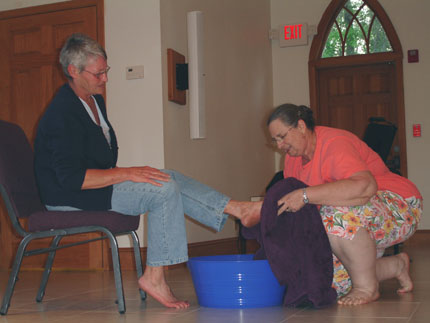 I have a question about what is appropriate to do at Holy Thursday Mass. When everyone gets up and washes each other's feet, with an invitation to every single parishioner to have their feet washed as well as do the washing for others, what should our family do? Do we participate at all? Do we leave it up to each of our personal consciences as to whether or not to participate? Do we sit out, thereby being the only family to do so?
I have not participated at all since moving here (this will be our fifth Easter here), but I'm wondering if I'm being purposefully obstinate about it, or if I should sit it out. And what about my girls, who want to participate?
I am at a loss as to what to do here, and I'm certain that sitting out as a family and refusing to participate has been the wrong thing to do.

So, have at it in the comboxes. Do we go with the flow? "When in Rome" and all that? What should we do?
Wednesday, March 5
Do Me a Favor, Please
If you are a Wordless Wednesday participant, could you please try out the widget at the bottom of my WW post? I just put it in and wanted to be sure it worked.
Thanks!
Please browse my eBay items. Thank you.
Thanks!
Monday, February 18
Apologetics Help Needed, Please!!
(Update: I am leaving this at the top of the blog for a few days to keep it in view for those who visit the actual blog rather than read through an aggregator.)
I am debating someone about the priesthood right now. Several points were brought up (by me) first, but only one point was rebutted. The points I brought up were question and answer sessions during Mass, whether the Church would ever allow women to be ordained, and the ministerial priesthood in the early Church (as in, did it exist or not). Only the last point was rebutted, and I am HIGHLY skeptical of the answer and sources, especially since "McBrian, Richard" is one of them.
Other sources are Joseph Martos (Doors to the Sacred), Kenan Osborne ("A History of the Orained Ministry in the Roman Catholic Church"), and a report by the Pontifical Biblical Commission from 1976, the translation of which can be found in Origins (and was cited by - shudder - the WomenPriests group online). I think it's the report they did on whether or not the Bible definitively excludes women from the priesthood. (Of course, being Catholic, we should know better than to use sola Scriptura to defend a position, right?)
The person I'm debating this with is a Catholic, by the way. Just wanted to be clear about that. When I wrote, I quoted papal documents and the Catechism to support that women will never be ordained. But I didn't quote specific sources on the fact that Jesus gave us the priesthood, that the Apostles were the first priests, etc. I mean, it's a basic Catechism lesson in my girls' books! I learned it in the second grade!
However, I need help with finding resources to rebut this new line of argument, and I am turning to you, dear readers. (Passing this on to people who can help would be great, too!)
I'll give you the exact respose I received (aside from the email to which it was attached, which reveals who the person is). I'm trying to be vague about this to keep identities secret, but I'd really like to be able to answer these questions. (I'll be looking in my Catechism and Compendium today between school and baking.)
Here is the response:
*********************************
None of this seems exactly right. It's as though it's clouded and geared, not towards discovering the truth (or Truth), but towards proving something already believed. I feel as though the purpose is to confuse rather than to enlighten.
To make something clear about my views on this, I'd like to add that I did, at one time, believe that women ought to be ordained, did not understand the difference between the ministerial priesthood and the layity's priesthood, and gradually did research to learn more about my faith. I have been educated quite a bit by Catholic Answers' site (for all ten years they've been there, believe it or not!). I try very hard to stick with those who don't dissent because I've learned that you can't be Catholic and refuse to accept the authority of the Church. (Not a good Catholic, anyway.) I also have learned a lot at the knee of Mother Angelica and her wonderful ministry. But I want to make it clear that oftentimes, when I searched for answers on something the Church teaches, I had to come to the hard truth that I wasn't in line with the Church. I sought to understand the teaching, and I seek daily to assent to Holy Mother Church. My own opinion hasn't anything to do with what I need to assent to. (Just ask me some time about my struggles with the death penalty!)
Help is appreciated, especially with understanding who these sources are, and, perhaps, where this essay came from, as I also suspect it is not his own. (Just a suspicion, and I'd be glad to admit I'm wrong if I am!)
Thank you in advance.
I am debating someone about the priesthood right now. Several points were brought up (by me) first, but only one point was rebutted. The points I brought up were question and answer sessions during Mass, whether the Church would ever allow women to be ordained, and the ministerial priesthood in the early Church (as in, did it exist or not). Only the last point was rebutted, and I am HIGHLY skeptical of the answer and sources, especially since "McBrian, Richard" is one of them.
Other sources are Joseph Martos (Doors to the Sacred), Kenan Osborne ("A History of the Orained Ministry in the Roman Catholic Church"), and a report by the Pontifical Biblical Commission from 1976, the translation of which can be found in Origins (and was cited by - shudder - the WomenPriests group online). I think it's the report they did on whether or not the Bible definitively excludes women from the priesthood. (Of course, being Catholic, we should know better than to use sola Scriptura to defend a position, right?)
The person I'm debating this with is a Catholic, by the way. Just wanted to be clear about that. When I wrote, I quoted papal documents and the Catechism to support that women will never be ordained. But I didn't quote specific sources on the fact that Jesus gave us the priesthood, that the Apostles were the first priests, etc. I mean, it's a basic Catechism lesson in my girls' books! I learned it in the second grade!
However, I need help with finding resources to rebut this new line of argument, and I am turning to you, dear readers. (Passing this on to people who can help would be great, too!)
I'll give you the exact respose I received (aside from the email to which it was attached, which reveals who the person is). I'm trying to be vague about this to keep identities secret, but I'd really like to be able to answer these questions. (I'll be looking in my Catechism and Compendium today between school and baking.)
Here is the response:
It would be erroneous on our part to assume that the presently existing model of priesthood was the norm for ministry in the first century A.D. Though there is sometimes confusion in this matter, it really cannot be proven historically that ordained priesthood was a part of the Christian experience at that period of time. “The earliest Christian community contained a variety of ministries, but priesthood was not one of them.”[1]
The early Christian community used different names for their ministries, but none of them was specifically designated to describe the Christian priesthood of any individual. The Jesus priesthood described in the letter to the Hebrews (written by an unknown Christian) should be “understood in the light of the Old Testament.”[2] This is very easily explainable, knowing that the priesthood Jesus and his followers knew was the Jewish temple priesthood, which was quite different from today’s Catholic priesthood. “The Early Church did not use the liturgical or sacred title of “priest” [in Greek, hiereus; in Hebrew, cohen] for Church ministers. Even though this title was readily available, it was evidently shunned by the early Church for designation of its ministries. In the New Testament only the Jewish priests, Jesus [and only in Hebrews] and all of the baptized are called: hiereus.”[3]
Some of the New Testament names of ministry are: Apostle, The Twelve, Prophet, Teacher, Diakonoi (could be applied to women; the Greek is masculine, as well)[4], Father, Servant, Episcopes, Overseer, Presbyteros, Evangelist, etc. “If we look at the Pauline material, which is the oldest written material (but not the oldest in tradition), we find that there is scant attention to either episcopos or diakonos and absolutely none to presbyter.”[5] Let us just pause for a minute to explain some of the ministry names used in the New Testament, since today they tend to mean something different:
- Episcopes – probably of Greek-Christian origin signifying a title of office, oversight task. Men who performed the function of oversight were called episcopos: governor, officer, building inspector, director, temple inspector.
- Presbyteros– probably of Jewish-Christian origin signifying the leaders in the great families and clans of the Jewish nation. This particular title goes back to the times of the patriarchs. “The term, presbyter, as used in the Jewish world, did not include liturgical functions. It was not “priestly” in its connotation. It was rather leadership and service to the community that marked one as an elder.”[6]
- Diakonoi (Deacon) – served the internal needs of the community. If they were women they should be like men¾respectable, discreet, and reliable[7] (1 Timothy 3:8-13; Romans 16:1). “According to the witness of the New Testament, especially the Pauline epistles, women are associated with the different charismatic ministries (diaconies) of the Church (1 Cor 12, 4; I Tim 3, 11, cf.8); prophecy, service, probably even apostolate…without, nevertheless, being of the Twelve. They have a place in the liturgy at least as prophetesses (1 Cor 11,4).”[8]
There was no ordination rite, as we understand it today, that we can find in the New Testament (either for men or for women), but the priesthood we know today is a combination of different roles and ministries that we find in the New Testament. “It is not even clear, for example, that anyone in particular was commissioned to preside over the Eucharist in the beginning. Paul never mentions that he presided. In fact, he seems to have been little involved in the administration of sacraments (1 Corinthians 1:14-15). There is no explicit mention that any of the Apostles presided over the Eucharist. Indeed, there is no compelling evidence that they presided when they were present, or that a chain of ordination from Apostle to bishop to priest was required for presiding. Someone must have presided, of course, and those who did so presided with the approval of the community.”[9]
Before the end of the first century, some Christian writers likened Jesus’ death on the cross to a priestly sacrifice, and since then we can see a slow development of the priesthood idea in the Christian circles. It was not until the third century that those presiding over Eucharistic celebrations were perceived as priestly ministers. It was not until the patristic and middle ages that almost all those engaged in the official church ministries had to be priests. “Significantly, not until the year 1208 is there an official declaration that priestly ordination is necessary to celebrate the Eucharist (Innocent III, Profession of Faith Prescribed to the Waldensians), and then, more solemnly, by the Council of Florence (1439) and the Council of Trent (1563).”[10]
This, however, is beyond the scope of this short essay.
[1] Martos, Joseph. Doors to the Sacred. P. 400
[2] McBrian, Richard. Catholiscism. P. 799.
[3] Osborne, Kenan. A History of the Ordained Ministry in the Roman Catholic Church. P. 83
[4] Osborne, Kenan. A History of the Ordained Ministry in the Roman Catholic Church. P. 43.
[5] Osborne, Kenan. A History of the Ordained Ministry in the Roman Catholic Church. P. 44.
[6] Osborne, Kenan. A History of the Ordained Ministry in the Roman Catholic Church. P. 47.
[7] Martos, Joseph. Doors to the Sacred. P. 406.
[8] The Pontifical Biblical Commission. English translation of this report can be found in Origins, v.6 (July 1, 1976) pp. 92-96.
[9] McBrian, Richard. Catholiscism. P. 801-802.[10] McBrian, Richard. Catholiscism. P. 803.
*********************************
*********************************
None of this seems exactly right. It's as though it's clouded and geared, not towards discovering the truth (or Truth), but towards proving something already believed. I feel as though the purpose is to confuse rather than to enlighten.
To make something clear about my views on this, I'd like to add that I did, at one time, believe that women ought to be ordained, did not understand the difference between the ministerial priesthood and the layity's priesthood, and gradually did research to learn more about my faith. I have been educated quite a bit by Catholic Answers' site (for all ten years they've been there, believe it or not!). I try very hard to stick with those who don't dissent because I've learned that you can't be Catholic and refuse to accept the authority of the Church. (Not a good Catholic, anyway.) I also have learned a lot at the knee of Mother Angelica and her wonderful ministry. But I want to make it clear that oftentimes, when I searched for answers on something the Church teaches, I had to come to the hard truth that I wasn't in line with the Church. I sought to understand the teaching, and I seek daily to assent to Holy Mother Church. My own opinion hasn't anything to do with what I need to assent to. (Just ask me some time about my struggles with the death penalty!)
Help is appreciated, especially with understanding who these sources are, and, perhaps, where this essay came from, as I also suspect it is not his own. (Just a suspicion, and I'd be glad to admit I'm wrong if I am!)
Thank you in advance.
Friday, February 1
Information, Please!
Last year, some clever Catholic blogger gave a history of the ties between Groundhog Day (the day, not the movie) and Candlemas (also known as the Dedication of Our Lord, 40 days after His birth).
I'd love to share that information with my girls, but I don't recall who wrote it! If you know of where I can find the information, I'd appreciate it!
Thanks in advance!
Please browse my eBay items. Thank you.
I'd love to share that information with my girls, but I don't recall who wrote it! If you know of where I can find the information, I'd appreciate it!
Thanks in advance!
Please browse my eBay items. Thank you.
Monday, January 28
Help! *Caveat Added*

I was an Independent Business Owner under Amway/Quixtar for years. For longer than I've been married. For various reasons, we did not renew and don't plan to. But now I'm in a quandry.
I have used nothing but Amway laundry products for more than 15 years, and now that I'll not be buying those any more, I have NO CLUE what works well and is cost-effective. Let me tell you this: Amway's laundry products ROCK. They are most of why we continued to renew our business license for the last few years. Amway's stuff gets anything and everything out of your laundry.
So what else works? Please help me out here, as I'll be needing to buy laundry detergent before February is out. I've already settled on fabric softener (I resisted the cutie bear and went with Downy) and have been using Shout lately (though I resent having to pre-treat so long before I wash something; I'd use the Amway stuff as I dropped it into the washer and it worked). But detergent ... ah, here I am stuck!
Some basics: I like stuff that's concentrated, I don't mind if it's powder or liquid, and I'm willing to pay a little bit extra if it's that much better. I like a deal, but if I have to wash something twice to get stains out, that's not a deal to me.
*Added Caveat*
I forgot to mention, in case it makes a difference, that we are on a septic system. Barb's comment about pipes reminded me that I might need to mention that. :)
Thanks for the help so far, ladies!
Okay, moms! Let me know what you use and how you like it!
Monday, December 17
Jesse Tree Bleg

I am wondering how wrapping up the Jesse Tree works when you have such a short fourth week of Advent. If your family does the Jesse Tree, could you let me know how to handle this last week, which has one Sunday reading and then just Christmas Eve? Do I just skip those readings and do them in the years when they are naturally a part of the calendar, or do we read them ALL on Sunday and Monday?
Thanks in advance for your help!
Please browse my eBay items. Thank you.
Tuesday, November 13

Thursday, October 18
Photography Bleg
Dad gave me his old camera (Thanks, Dad!!), and I am thrilled. Bought the battery for the F-stop. Installed. Got ready to change rolls of film and can't get the back open. (Will ask Dad for instructions on that.)

But, here's my bigger problem. I have no owner's manual for this camera, and I can't get one from Minolta (or KonicaMinolta) because they don't do that any more. Imagine! KonicaMinolta doesn't do cameras!!
Anyway, my bleg for the day is this:
Please let me know if you know of anywhere I can access a .pdf file or anything of the sort that gives me some semblance of an owner's manual. I just would like to learn a bit more about using a manual camera, especially since the last time I used this one was probably about 14 years ago.
Many, many thanks!
Wednesday, August 29
FAST Bleg
Okay, all, this is a late request. I'm wondering if anyone knows of a good place to eat in New Bern, North Carolina. Nathan and I are going (it feels funny not to call him Hubby now), and I keep forgetting that we are leaving Friday morning. *sigh* It's just the two of us, and we are planning on eating local on Friday night and all day Saturday.
I know we'll probably eat at The Flame (a steakhouse) on Saturday night, just for something nice, but we want to try out other places in the area. We're not heading to the lighthouses or anything - just wandering the town alone.
Anyone been there who has a suggestion? Or a warning?
The kicker here is that I'd need an answer in the next 24 hours (about 6 on Thursday).
Thanks in advance for any assistance!
I know we'll probably eat at The Flame (a steakhouse) on Saturday night, just for something nice, but we want to try out other places in the area. We're not heading to the lighthouses or anything - just wandering the town alone.
Anyone been there who has a suggestion? Or a warning?
The kicker here is that I'd need an answer in the next 24 hours (about 6 on Thursday).
Thanks in advance for any assistance!
Monday, June 11
Homeschooling Bleg
Someone recently posted about lessons you can do in a unit study on The Trumpet of the Swan. Anyone recall who did it or where I can find the post on that?
Thanks in advance.
Thanks in advance.
Thursday, April 26
Question on GIRM
After watching the video below, I am curious about something, and I will freely admit that I probably can find the answer in the GIRM but have not read through the entire thing.
After a regular Sunday Mass, it is ever permissible to strip the altar of all linens?
And, in addition, what linens are required as a minimum to be used on the altar?
I noticed in the video below, the priests never took the linen off the altar at the beginning, and I am wondering if the altar is supposed to be covered at all times with the obvious exception of after Holy Thursday Mass. I know that the altar is a symbol of Christ, and I suspect that it is inappropriate to strip it of all linens after every Mass (or after Holy Communion).
Anyone have any information on this topic?
After a regular Sunday Mass, it is ever permissible to strip the altar of all linens?
And, in addition, what linens are required as a minimum to be used on the altar?
I noticed in the video below, the priests never took the linen off the altar at the beginning, and I am wondering if the altar is supposed to be covered at all times with the obvious exception of after Holy Thursday Mass. I know that the altar is a symbol of Christ, and I suspect that it is inappropriate to strip it of all linens after every Mass (or after Holy Communion).
Anyone have any information on this topic?
Monday, February 19
Lenten Bleg
Someone posted a wonderful project for Lent that consisted of making a crown of thorns with bread dough and toothpicks, which is baked until hard and then the toothpicks are taken out when good deeds are done (to show that it eases Christ's sufferings when we do as He asks).
I cannot for the life of me find that post or an article on the project. If you've done this project as a family, could you please leave a message in the com boxes here so that I can do said project with my girls?
Thanks a million!
I cannot for the life of me find that post or an article on the project. If you've done this project as a family, could you please leave a message in the com boxes here so that I can do said project with my girls?
Thanks a million!
Monday, November 20
Question for the Smarty-Pants Types
Suppose you go to Mass, and you feel queasy. Later, after receiving Communion, you wind up getting sick.
What happens if you throw up before you have completely digested the Eucharist?
This isn't something I'd thought about before, but it has come up (if you'll pardon the expression) this evening.
Just curious...leave answers in the com boxes if you have them. Thanks in advance.
What happens if you throw up before you have completely digested the Eucharist?
This isn't something I'd thought about before, but it has come up (if you'll pardon the expression) this evening.
Just curious...leave answers in the com boxes if you have them. Thanks in advance.
Subscribe to:
Posts (Atom)
LinkWithin
