Showing posts with label saints. Show all posts

Wednesday, August 11

Perfect Intellect and the Blessed Virgin Mary

Our family prayed the Rosary last night, and while meditating on the Sorrowful Mysteries, I tried to ask God to help me develop certain qualities - ones that would help me be a better imitator of our Lord and His Blessed Mother.

I was meditating on the Agony in the Garden, and I thought about how I need to learn to submit to God's Will in my life. I need to be less selfish - less of a control freak - and trust God. This is what Jesus did during His Agony; He submitted Himself to the Will and the Plan of the Father.

As I meditated more, I thought of His Blessed Mother's submission to the Will of God. Her assent - her fiat - was perfect. Her will was in union with God's. Submission was a pleasure for her, and this was helped by the fact that her soul did not carry the scars of Original Sin. For an explanation of this important doctrine of the Catholic Church (called the Immaculate Conception), Catholic Answers offers, in part, the following:

The Immaculate Conception
It’s important to understand what the doctrine of the Immaculate Conception is and what it is not. Some people think the term refers to Christ’s conception in Mary’s womb without the intervention of a human father; but that is the Virgin Birth. Others think the Immaculate Conception means Mary was conceived "by the power of the Holy Spirit," in the way Jesus was, but that, too, is incorrect. The Immaculate Conception means that Mary, whose conception was brought about the normal way, was conceived without original sin or its stain—that’s what "immaculate" means: without stain. The essence of original sin consists in the deprivation of sanctifying grace, and its stain is a corrupt nature. Mary was preserved from these defects by God’s grace; from the first instant of her existence she was in the state of sanctifying grace and was free from the corrupt nature original sin brings.
When discussing the Immaculate Conception, an implicit reference may be found in the angel’s greeting to Mary. The angel Gabriel said, "Hail, full of grace, the Lord is with you" (Luke 1:28). The phrase "full of grace" is a translation of the Greek word kecharitomene. It therefore expresses a characteristic quality of Mary.
The traditional translation, "full of grace," is better than the one found in many recent versions of the New Testament, which give something along the lines of "highly favored daughter." Mary was indeed a highly favored daughter of God, but the Greek implies more than that (and it never mentions the word for "daughter"). The grace given to Mary is at once permanent and of a unique kind. Kecharitomene is a perfect passive participle of charitoo, meaning "to fill or endow with grace." Since this term is in the perfect tense, it indicates that Mary was graced in the past but with continuing effects in the present. So, the grace Mary enjoyed was not a result of the angel’s visit. In fact, Catholics hold, it extended over the whole of her life, from conception onward. She was in a state of sanctifying grace from the first moment of her existence. ...

(For the exact definition, broken down bit-by-bit with explanations, see the Catholic Encyclopedia at the New Advent site.)

Because Mary was conceived without Original Sin, she was in a better position to accept God's Divine Will and to align her own desires with His. Instead of her judgement being clouded by the aftereffects of The Fall, she was able to remain without sin throughout her life.

Which led me to ponder further...

When Adam and Eve were created, they had an enlightened intellect. In other words, they had innate knowledge of God and His Will. They could freely choose to accept or reject this (and we all know how that ended up), but they knew full well what that Will was. It was the sin of Pride that led to the Fall, hence "Pride comes before the Fall." But, make no mistake, they were smart enough to know what they were doing. Our intellects are not clear, they are not complete. Our intellects are like broken bones that are not quite healed properly. We are weak, our souls are weak, and our wills are weak. Anyone who thinks they are different is wrong, for even Saint Paul lamented that he was unable to avoid sinning (Romans 7:15).

But Mary - she was preserved from Original Sin, pre-emptively given the very Salvation that Christ Jesus would offer to us all. This is a basic belief that the Church has held since the earliest days of Christianity. Catholic Answers points to St. Irenaeus' writings in the Second Century:

"Consequently, then, Mary the Virgin is found to be obedient, saying, ‘Behold, O Lord, your handmaid; be it done to me according to your word.’ Eve, however, was disobedient, and, when yet a virgin, she did not obey. Just as she, who was then still a virgin although she had Adam for a husband—for in paradise they were both naked but were not ashamed; for, having been created only a short time, they had no understanding of the procreation of children, and it was necessary that they first come to maturity before beginning to multiply—having become disobedient, was made the cause of death for herself and for the whole human race; so also Mary, betrothed to a man but nevertheless still a virgin, being obedient, was made the cause of salvation for herself and for the whole human race. . . . Thus, the knot of Eve’s disobedience was loosed by the obedience of Mary. What the virgin Eve had bound in unbelief, the Virgin Mary loosed through faith" (Against Heresies 3:22:24 [A.D. 189]).
"The Lord then was manifestly coming to his own things, and was sustaining them by means of that creation that is supported by himself. He was making a recapitulation of that disobedience that had occurred in connection with a tree, through the obedience that was upon a tree [i.e., the cross]. Furthermore, the original deception was to be done away with—the deception by which that virgin Eve (who was already espoused to a man) was unhappily misled. That this was to be overturned was happily announced through means of the truth by the angel to the Virgin Mary (who was also [espoused] to a man). . . . So if Eve disobeyed God, yet Mary was persuaded to be obedient to God. In this way, the Virgin Mary might become the advocate of the virgin Eve. And thus, as the human race fell into bondage to death by means of a virgin, so it is rescued by a virgin. Virginal disobedience has been balanced in the opposite scale by virginal obedience. For in the same way, the sin of the first created man received amendment by the correction of the First-Begotten" (ibid., 5:19:1 [A.D. 189]).

So if the Blessed Virgin Mary was without sin - and without the broken-ness that comes from being born with Original Sin on one's soul, does this mean that she, too, had a perfect intellect, as Eve did before the Fall?

If you know, please, point me towards some information on this. It's fascinating to me that Mary might have had the same perfect intellect that our First Parents had!


Thursday, January 28

Reminder to Self

"Leave at the door of the place where you are going to converse with God all extraneous thoughts, saying, with St. Bernard, "O my thoughts, wait here. After prayer we shall speak about other matters."

--St. Alphonsus Liguori


[quote via Daily Gracelines from Women of Grace]

Tuesday, March 17

Saint Patrick's Breastplate

New Advent has a lot of information on Saint Patrick, as well as this prayer.  I love the entire thing.  What a beautiful way to pray!

I bind to myself today
The strong 
virtue of the Invocation of the Trinity:
I 
believe the Trinity in the Unity
The Creator of the Universe.

I bind to myself today
The 
virtue of the Incarnation of Christ with His Baptism,
The 
virtue of His crucifixion with His burial,
The 
virtue of His Resurrection with His Ascension,
The 
virtue of His coming on the Judgement Day.

I bind to myself today
The 
virtue of the love of seraphim,
In the obedience of 
angels,
In the 
hope of resurrection unto reward,
In 
prayers of Patriarchs,
In predictions of 
Prophets,
In preaching of 
Apostles,
In 
faith of Confessors,
In purity of 
holy Virgins,
In deeds of righteous men.

I bind to myself today
The power of 
Heaven,
The light of the sun,
The brightness of the moon,
The splendour of fire,
The flashing of lightning,
The swiftness of wind,
The depth of sea,
The stability of earth,
The compactness of rocks.

I bind to myself today
God's Power to guide me,
God's Might to uphold me,
God's Wisdom to teach me,
God's Eye to watch over me,
God's Ear to hear me,
God's Word to give me speech,
God's Hand to guide me,
God's Way to lie before me,
God's Shield to shelter me,
God's Host to secure me,
Against the snares of 
demons,
Against the seductions of 
vices,
Against the lusts of 
nature,
Against everyone who meditates injury to me,
Whether far or near,
Whether few or with many.

I invoke today all these 
virtues
Against every hostile merciless power
Which may assail my body and my 
soul,
Against the incantations of 
false prophets,
Against the black 
laws of heathenism,
Against the 
false laws of heresy,
Against the deceits of 
idolatry,
Against the spells of 
women, and smiths, and druids,
Against every 
knowledge that binds the soul of man.

Christ, protect me today
Against every poison, against burning,
Against drowning, against death-wound,
That I may receive abundant reward.

Christ with me, Christ before me,
Christ behind me, Christ within me,
Christ beneath me, Christ above me,
Christ at my right, Christ at my left,
Christ in the fort,
Christ in the chariot seat,
Christ in the poop [deck],
Christ in the heart of everyone who thinks of me,
Christ in the mouth of everyone who speaks to me,
Christ in every eye that sees me,
Christ in every ear that hears me.

I bind to myself today
The strong 
virtue of an invocation of the Trinity,
I 
believe the Trinity in the Unity
The Creator of the Universe.


Why Reinvent the Wheel?

It's Saint Patrick's feast day.  No, that doesn't mean you are supposed to drink unholy amounts of beer or gorge yourself on corned beef and cabbage.  It is Lent, remember?

I'd post about the wonderful man who converted Ireland, but Jay's done such a nice job.  Just go read his summary and links.  :)

No time for lengthy reading?  Just check out this nice, kid-friendly summary:


Friday, April 4

"I Want to be Like You"

My music video. A Catholic version of FFH's song.

I'll put it up on the sidebars of both blogs, too.


Please browse my eBay items. Thank you.

Friday, February 22

Would Saint Patrick Celebrate? (Multiple Updates)

There seems to be a lot of hubbub about Saint Patrick's Day falling during Holy Week. "It's not fair!" whine the people who want parties. "We shouldn't have to stop celebrating just because it's Holy Week!"

Excuse me, people, but aren't you placing your emphasis on the wrong person here? There's Someone who is the focus of Holy Week, and Saint Patrick would be among the first to say it ain't him.

And as far as the dispensations for corned beef when it falls on a Friday (it's always during Lent), that's a total crock, too.

Instead of placating people and allowing them to do stuff that just might offend the Lord, why not take a moment and educate folks on why we don't celebrate saints during Holy Week. (Saint Joseph, patron and protector of the Church, has had his day moved to the 15th this year.) We don't celebrate saints that week because our focus is on CHRIST! Christ Jesus, Who suffered and died a grusome death for us in the first Holy Week. Christ Jesus, Who is Lord of lords. Christ Jesus, the One who pleads for us at the right hand of the Father.

Saint Patrick would be embarrassed by this kind of fuss, people. He'd wonder what on earth we were doing eating meat at ALL during Lent. Or eggs or dairy. Why aren't you fasting throughout Lent? would probably be a question he'd ask. Where is your penance?

I'm Irish, too. My great-grandfather came here from Ireland, so I'm third-generation from him. But this idea that "I'm Irish ... I have to celebrate" is just ridiculous.

Wouldn't it be lovely if the bishops who are giving dispensations for festivities during Holy Week would, instead, take the time to discuss with their flock the meaning of Holy Week and why we aren't supposed to celebrate anyone but Christ that week?

And people wonder why Protestants get confused about our love of saints. Misplaced, this is. It's taking Saint Patrick out of his proper place and elevating him.


[images from EWTN]

Updates:

  • Jay has more on it (along with his own witty comments) here.
  • Ironic Catholic has some comments on the same article here.


Please browse my eBay items. Thank you.

Thursday, December 6

Jolly and Good-Natured, or Pugilist?


New to my blogroll is The Charcoal Fire, written by the son of one of my friends. (He's under Catholic Dads, but that is pre-emptively - the baby is due next month.)


Since today is Saint Nicholas' feast day, I thought I'd share his post on the beloved saint with you. It's called "Saint Nicholas: Icon of Intolerance."
Here's a sample:


Since we're well into the Christmas season by consumeristic standards, I've decided, by inspiration from my beautiful wife, that I should burst a big, fat, jolly, red bubble. So if you like your big, fat, jolly red bubble, hit your back arrow at the top of your browser and say, "Whew! I almost lost my big, fat, jolly, red bubble!" But if you want to know what the original Santa did to an inaugural member of the "naughty list," please, read on. Trust me, you want this bubble burst. The real St. Nicholas is way cooler than the jolly fat man of Western lore.


St. Nicholas lived from 270 to 343 A.D. in modern-day Turkey. He lived in an era of great Christian persecution and trial. Most people have heard the following story about St. Nicholas:


A poor man had three young daughters whose dowries he could not afford. Because of this, they faced a future dark with poverty and prostitution. St. Nicholas is said to have heard of the plight of the poor father. He knew such a future was no future at all. One night under cover of darkness, he filled a bag of coins and "dropped them down the chimney" of the poor man's house (in reality, he probably threw them in the window) to cover the eldest daughter's dowry. The next night, he dropped another bag of coins down the chimney. The father, now realizing someone had heard of his plight knew that the "Good Samaritan" would be returning a third night in his generosity to cover the youngest daughter's dowry. Though it is unknown whether the father prepared M&M cookies and milk, he stayed awake to discover the identity of the humble benefactor. It was Nicholas. Had the father not stayed awake, no one would have ever known it was him.


This is a very lovely story indeed! Nicholas did many very wonderful things, some of which follow.


Many might consider the following events of Nicholas' life acts of intolerance. To get to what is relevant for our purposes, we have to know more about the man beyond the legend. Nicholas one night had a vision of the Lord Jesus in glory holding the jewel-adorned Gospels and standing beside Nicholas. On Nicholas' other side was the Blessed Mother of God, the Virgin Mary, holding a bishop's stole. Shortly after his vision, the Church named Nicholas bishop of Myra. Nicholas served as bishop during a difficult, but profoundly fruitful, time for Christianity. As bishop, he was arrested, tortured, and imprisoned during the oppressive Roman persecutions (much as Catholic bishops are being treated in the same manner in China at this very moment). However, when Emperor Constantine converted, he released many imprisoned bishops, including Nicholas, who returned to his people. Christianity was now legal throughout the Roman Empire.


Intolerant Santa alert! Many pagan worship practices were still observed throughout Nicholas' diocese. Many people in Asia Minor continued to worship the Greek fertility goddess Artemis, daughter of Zeus. Nicholas knew that as bishop, he had to care for the souls of his flock, who might flock back to what he knew to be a demon-inspired fertility cult. He set out to destroy the shrines and expel the demons from the land. And so it was: through Nicholas' life-long efforts, the once-magnificent temple of Artemis in Myra and several other temples were razed to the ground. ...


And it continues on. There's even a great picture - looks a bit like an icon, but I don't think it is - of the good bishop sucker-punching Arius! What's not to love?

Thursday, August 9

Coming up on EWTN

My girls love to hear stories of the saints. When Hubby was asked at work who the girls look up to - Hannah Montana, perhaps? - he thought for a moment and said, "Well, I think they mostly look up to the saints that they are learning about in school."

They will probably really love to see these programs, which is why I will be recording them when they air.


ST. CLARE OF ASSISI A look at the life of St. Clare of Assisi (foundress of the Poor Clares), captivated by the burning words of St. Francis, she forsook her noble heritage and embraced a life of poverty out of love for Christ and Him Crucified.
Aug 11 8:00 PM
Aug 12, 2:00 AM
Aug 16 1:00 PM

also
FRANCIS AND CLARE OF ASSISIA documentary look at the lives of St. Francis and Clare of Assisi, and how their love of Christ Crucified inspired many to reject the crass materialism and violence of the age.
Aug 11, 2:30 PM

More details on special programming on EWTN this month can be found at their website.

Christine

Tuesday, June 26

Saintly Quote

Received in today's Daily Grace Line from Women of Grace:


"Our Lady listens attentively to what God wants, ponders what she doesn't fully understand and asks about what she doesn't know. Then she gives herself completely to doing the divine Will."

-St. Josemaria Escriva


Friday, June 22

Saint John Fisher


Another martyr as a result of Henry VIII's schism from the Church. The Catholic Encyclopedia tells us this about Saint John Fisher:


When the question of Henry's divorce from Queen Catherine arose, Fisher became the Queen's chief supporter and most trusted counsellor. In this capacity he appeared on the Queen's behalf in the legates' court, where he startled his hearers by the directness of his language and most of all by declaring that, like St. John the Baptist, he was ready to die on behalf of the indissolubility of marriage. This statement was reported to Henry VIII, who was so enraged by it that he himself composed a long Latin address to the legates in answer to the bishop's speech. Fisher's copy of this still exists, with his manuscript annotations in the margin which show how little he feared the royal anger. The removal of the cause to Rome brought Fisher's personal share therein to an end, but the king never forgave him for what he had done. In November, 1529, the "Long Parliament" of Henry's reign began its series of encroachments on the Church. Fisher, as a member of the upper house, at once warned Parliament that such acts could only end in the utter destruction of the Church in England. On this the Commons, through their speaker, complained to the king that the bishop had disparaged Parliament. Dr. Gairdner (Lollardy and the Reformation, I, 442) says of this incident "it can hardly be a matter of doubt that this strange remonstrance was prompted by the king himself, and partly for personal uses of his own".


The opportunity was not lost. Henry summoned Fisher before him, demanding an explanation. This being given, Henry declared himself satisfied, leaving it to the Commons to declare that the explanation was inadequate, so that he appeared as a magnanimous sovereign, instead of Fisher's enemy.


A year later (1530) the continued encroachments on the Church moved the Bishops of Rochester, Bath, and Ely to appeal to the Apostolic see. This gave the king his opportunity. An edict forbidding such appeals was immediately issued, and the three bishops were arrested. Their imprisonment, however, can have lasted a few months only, for in February, 1531, Convocation mmet, and Fisher was present. This was the occasion when the clergy were forced, at a cost of 1000,000 pounds, to purchase the king's pardon for having recognized Cardinal Wolsey's authority as legate of the pope; and at the same time to acknowledge Henry as Supreme Head of the Church in England, to which phrase, however, the addition "so far as God's law permits" was made, through Fisher's efforts.


A few days later, several of the bishop's servants were taken ill after eating some porridge served to the household, and two actually died. Popular opinion at the time regarded this as an attempt on the bishop's life, although he himself chanced not to have taken any of the poisoned food. To disarm suspicion, the king not only expressed strong indignation at the crime, but caused a special Act of Parliament to be passed, whereby poisoning was to be accounted high treason, and the person guilty of it boiled to death. This sentence was actually carried out on the culprit, but it did not prevent what seems to have been a second attempt on Fisher's life soon afterwards.


Matters now moved rapidly. In May, 1532, Sir Thomas More resigned the chancellorship, and in June, Fisher preached publicly against the divorce. In August, Warham, Archbishop of Canterbury, died, and Cranmer was at once nominated to the pope as his successor. In January, 1533, Henry secretly went through the form of marriage with Anne Boleyn; Cranmer's consecration took place in March of the same year, and, a week later, Fisher was arrested. It seems fairly clear that the purpose of this arrest was to prevent his opposing the sentence of divorce which Cranmer pronounced in May, or the coronation of Anne Boleyn which followed on 1 June; for Fisher was set at liberty again within a fortnight of the latter event, no charge being made against him. In the autumn of this year (1533), various arrests were made in connexion with the so-called revelations of the Holy Maid of Kent, but as Fisher was taken seriously ill in December, proceedings against him were postponed for a time. In March, 1534, however, a special bill of attainder against the Bishop of Rochester and others for complicity in the matter of the Nun of Kent was introduced and passed. By this Fisher was condemned to forfeiture of all his personal estate and to be imprisoned during the king's pleasure. Subsequently a pardon was granted him on payment of a fine of 300 pounds.


In the same session of Parliament was passed the Act of Succession, by which all who should be called upon to do so were compelled to take an oath of succession, acknowledging the issue of Henry and Anne as legitimate heirs to the throne, under pain of being guilty of misprision of treason. Fisher refused the oath and was sent to the Tower of London, 26 April, 1534. Several efforts were made to induce him to submit, but without effect, and in November he was a second time attained of misprision of treason, his goods being forfeited as from 1 March preceding, and the See of Rochester being declared vacant as from 2 June following. A long letter exists, written from the Tower by the bishop to Thomas Cromwell, which records the severity of his confinement and the sufferings he endured.


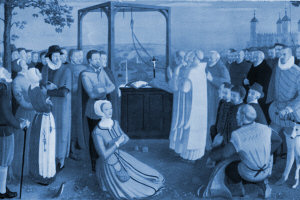
In May, 1535, the new pope, Paul III, created Fisher Cardinal Priest of St. Vitalis, his motive being apparently to induce Henry by this mark of esteem to treat the bishop less severely. The effect was precisely the reverse. Henry forbade the cardinal's hat to be brought into England, declaring that he would send the head to Rome instead. In June a special commission for Fisher's trial was issued, and on 17 June he was arraigned in Westminster Hall on a charge of treason, in that he denied the king to be supreme head of the Church. Since he had been deprived of his bishopric by the Act of Attainder, he was treated as a commoner, and tried by jury. He was declared guilty, and condemned to be hanged, drawn, and quartered at Tyburn, but the mode of execution was changed, and instead he was beheaded on Tower Hill.


The martyr's last moments were thoroughly in keeping with his previous life. He met death with a calm dignified courage which profoundly impressed all present. His headless body was stripped and left on the scaffold till evening, when it was thrown naked into a grave in the churchyard of Allhallows, Barking. Thence it was removed a fortnight later and laid beside that of Sir Thomas More in the church of St. Peter ad Vincula by the Tower. His head was stuck upon a pole on London Bridge, but its ruddy and lifelike appearance excited so much attention that, after a fortnight, it was thrown into the Thames, its place being taken by that of Sir Thomas More, whose martyrdom occurred on 6 July next following.


There is more, which you can read here.


Tuesday, June 19

What a History! (Update at End)


Gracious, every time I learn something new about the beginnings of the Anglican Church/Church of England/Episcopal Church (aren't they all various sub-sets of the same denomination?), I get more disgusted. People were bullied into that sham, and there were so many martyrs who remained loyal to the Church (you know, the actual Church, not the one started by a bratty, spoiled king).


Check out what Red Neck Woman tells us about Blessed John Davy:


Blessed John Davy († 1537)

By Red Neck Woman

John Davy, a Carthusian choir monk and deacon was one of ten religious of the order's London monastery, the Charterhouse, who on May 18, 1537 refused to join twenty of their fellow Carthusians in taking King Henry VIII's odious anti-papal oath of supremacy. Eleven days later, the ten were brought to a London prison, where they were chained in a standing position with their hands behind their backs, left thus to starve to death. After learning of their fate, Margaret (Gigs) Clement, an adopted daughter of the martyr Saint Thomas More, bribed the jailer to let her enter the prison. Disguised as a milkmaid, she placed bits of meat into the mouths of the starving monks and cleaned their cell. When after some time the king expressed surprise that the prisoners were still alive, the jailer, fearing the king's wrath, refused to allow Margaret to continue her missions of mercy. All but one of the men soon perished from hunger. John Davy died on June 8, 1537. Years later, on her deathbed, Margaret saw in a vision the martyred Carthusians she had fed standing round her, inviting her to come with them to eternal life.


You can read more about Henry XVIII here and here, and more about the Carthusians who were martyred here. New Advent's entry on the Church of England and Anglicanism is found here.
UPDATE:
Jackie has been discussing the upcoming Walk of the Martyrs at her blog, Catholic Mom of 10. Sorry that I forgot! I've been reading the posts over as they've been coming, too. Silly me. Do pop over and check out her posts on the topic.

Wednesday, May 9

Converts from Islam

I was wondering about saints to whom I could go for intercessory prayer in relation to Muslims converting to Christianity. So I did a search at the Patron Saint site (very helpful site, you know).


These are the saints I came up with.


Memorial


Profile


Born to Muslim parents. She and her mother converted to Christianity - Flora was raised Christian, her brother Muslim. She was often abused at home for her faith. She took a private vow of chastity, and ministered to Christian prisoners. When her parents announced an arranged marriage to an Islamic man, Flora and her Christian friend Mary ran away, briefly hiding with the home of Flora's sister. The sister, however, feared being accused of harboring Christians, and threw the two out. Her brother publicly betrayed her to the Islamic authorities. She was imprisoned and scourged for her faith, escaped, was recaptured, and martyred.


Died


tortured and beheaded by Moors in 851 or 856 (sources vary on the year)


Canonized


Patronage


Also known as

Grace; Zaida

Memorial


Profile

Daughter of Almanzor, Muslim caliph of Lerida, Catalonia. Sister of Saint Bernard and Saint Mary. Convert, brought to the faith by her brother Bernard. The three tried to convert their brother Almanzor, who turned them over to Moorish authorities. Martyr.

Born

at Lerida, Catalonia as Zaida

Died


Canonized


Patronage

Also known as

Grace; Zaida

Memorial

Profile

Daughter of Almanzor, Muslim caliph of Lerida, Catalonia. Sister of Saint Bernard and Saint Grace. Convert, brought to the faith by her brother Bernard. The three tried to convert their brother Almanzor, who turned them over to Moorish authorities. Martyr.

Born

at Lerida, Catalonia as Zoraida

Died

Patronage

Also known as

Achmed

Memorial

Profile

Son of Almanzor, Muslim caliph of Lerida, Catalonia. Brother of Saint Mary and Saint Grace. Convert. Benedictine Cistercian monk at Poblet, taking the name Bernard. With his sisters, he tried to convert his brother Almanzor, who turned them over to Moorish authorities. Martyr.
Born
at Lerida, Catalonia as Achmed
Died
Patronage
Also known as
Abo of Tblisi; Abo of Tibileli
Memorial
Profile
Grew up Muslim. Perfumer to Nerses, the prince of Kartli, a region of eastern Georgia. As a young adult he became convinced of the truth of Christianity, but was afraid to convert openly as Georgia was under Muslim rule. For political reasons, his prince had to seek shelter in Khazaria north of the Caspian Sea, an area free of Muslim control; Abo and 300 other members of the court accompanied him, and Abo was baptized there. The prince and his party returned to Tblisi in 782, and for a few years Abo lived quietly as a "closet" Christian. However, in 786 he was exposed as a Christian, and tried for being a renegade from Islam. He confessed his faith at trial, was imprisoned, and martyred.
Born
8th century at Baghdad, Iraq
Died
beheaded 6 January 786 at Tblisi, Georgia; his body was burned on the edge of cliff, and his bones thrown off a bridge into the Kura River; his biographer, a contemporary named John Sabanisidze, swears a pillar of light was seen rising from the water the next day
Canonized

Additional Information

Life of Abo [russian]
I think I'll be talking to some new-found family members soon. :)

Tuesday, April 24

Saints Meme

I've been thinking about this meme, and since Esther left an open tag I thought I'd go ahead and do it for fun. (I know there have been other open tags, too, but I needed to think it over a little bit first.)

Here are the rules: You have to list your four favorite saints, one favorite blessed and someone who think should have been a saint. (For your entertainment, I added links to each saint's page at the Patron Saints Index.)

First is Saint Peter. Gosh, I love him so very much! Think of this past Sunday's Gospel. First, he jumps off the boat (which is headed the short 100 yards to shore already) so he can be the first one to get to Jesus! I love to close my eyes and imagine him running out of the water, half tripping and stumbling through the surf, and hugging Jesus with all his might! His enthusiasm is just fantastic! I love that he is quick to speak in the Gospels, though he often also seems slow to think about what he is saying. ("I'll follow you anywhere!" "Simon, you can't do that now. I'm going to die." "Oh, God forbid, Jesus!") I love that he has unbridled passion and love for Christ, even though he had to admit at the end of the Gospel reading on Sunday that he could not agape Christ, but could only philia him. I love how he jumped out of a boat and walked on the water until he realized, "Holy mackeral! I'm walking on the WATER, dude!!" and started to sink. If I were a boy, I might have taken Peter as my Confirmation name. (That is, if I'd been thinking about the saint instead of how the name sounded with the rest of my name.)

The rest of the saints in my list are not in any particular order.


Next is Saint Therese, the Little Flower. I love that she felt she was just too little to do big things, but that she could do small things with all of her heart and offer that to God. The idea that I can offer my small sacrifices and actions to God and that He can make something great of it...well, who wouldn't like that idea? I tell my girls all the time that they need only do small things with great love to be able to do God's will. When you are a little child, it's hard to imagine that anything you do can be helpful or good to God. Really, when you are "just" a stay-at-home wife and mother, it can feel the same way. Other people are doing great things. They write important articles that help change how people look at things. They deliver great lectures that inform consciences. They teach classes and educate students and fill their minds with the Great Truth. They travel overseas and meet Important People and exchange ideas. Maybe they even get to meet the pope or a cardinal while they travel through Rome. But here, at home, what Great Things am I doing? I am not doing any Great Thing. But my Small Things, when offered to Christ with Great Love, can afford me graces which I will not know the extent of until I reach my judgement day.


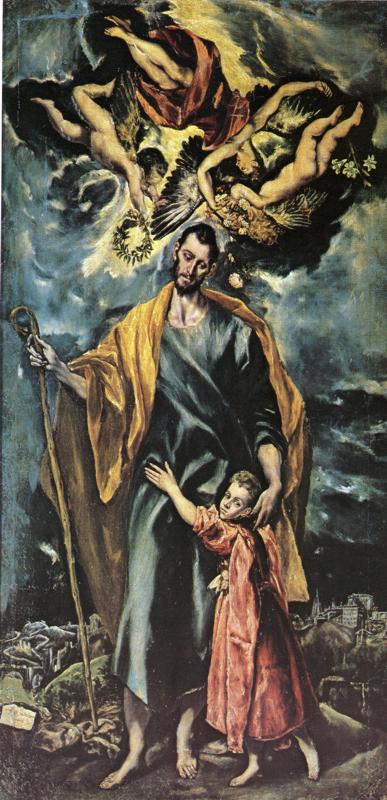
Saint Joseph, foster father of our Lord. Little is said about him in the Gospels, but imagine the faith he had! And his disposition was so gentle! Think of this: he wanted to divorce Mary quietly because he didn't want to cause her scandal. Then he was so open to God's will that he was able to follow the instructions of angels three times (that we are told of) in order to secure the safety of the Holy Family. First, in marrying Mary. Next, to flee to Egypt. Finally, to return to Israel to raise Jesus in Galilee. And to live a life consecrated to chastity such as his and the Blessed Mother's! Who in this time can imagine such dedication to the will of God? Saint Joseph is the patron of the Church, of a happy death, of fathers, of families, and on and on. He protected our Savior and raised Him to be a good and godly Man. He helped to educate Jesus! Can you imagine the responsibility? I can't.


Last, but certainly not least, is the Blessed Mother. Her life is mostly a mystery (if you only have the Bible, that is - sacred Tradition tells us a bit more, though it's still not a full biography). She lived a hidden life. Wife, mother, teacher to her Son. She was to protect Jesus as a child, to raise Him up. She helped Saint Joseph to teach the Child Jesus the faith. The fact that the Mother of God led a life similar to my own (wife, mother, teacher of my children) gives me comfort when I am feeling frustrated with my own life. I remember that Mary was able to do it all with grace and faith. Her complete dedication to God and His will is something that every person, male or female, ought to aspire towards.


My favorite blessed is probably Mother Teresa. I have always been very drawn to her. When I was a girl, I was fascinated by her missionary work, especially when I learned of the caste system that she blatantly ignored. I have a book of quotations by her called The Joy in Loving that absolutely puts me to shame every time I open it. I have two quotes that are from that book to share here.


I always say I am a little pencil in God's hands. He does the thinking. He does the writing. He does everything and sometimes it is really hard because it is a broken pencil and He has to sharpen it a little more. Be a little instrument in His hands so that He can use you any time, anywhere. We have only to say 'yes' to God.

And, boy, is it hard when it's time to be sharpened! That is, if we are even letting Him use us at all. Maybe we are the pencil that is hiding behind the couch in the living room, dropped there during last week's math lesson that was taken off to be worked on elsewhere. But, really, can we hide from God? Here's a hint: It didn't work very well for Adam and Eve, did it?


Dear God, when it comes to helping those in need, help me to see more than myself. I don't think there is anyone who needs God's grace and help more than I do. I feel so forsaken and confused at times. And I think that is exactly why God uses me, because I cannot claim any credit for what gets done. On the contrary I need His help twenty-four hours a day.
We know this is exactly what Saint Paul (another favorite!) was talking about. In our weaknesses, we can show the strength of God. When we are weak, but we still accomplish things, it only serves to show that it is really God behind it. I can attest to that. If this Mother's Day tea comes off at our parish, it will certainly be God's doing, not my own. I'm not a natural leader, and running a Respect Life meeting is nerve-wracking. But God gives me enough grace to do it.

Another thing about Blessed Teresa of Calcutta that I found amazing is that she went through a Dark Night of the Soul. Many people lose their faith when they face a time when they cannot feel God at all. Prayers seem to go into nothingness. You listen but aren't sure there is an answer at all. You feel completely abandonned - forsaken. I've been there, and, if you ask me, I failed the test miserably. But Blessed Teresa's writings to her spiritual mentor revealed that she went through a spiritual desert for the last forty years of her life. That was bascially the entire time she worked in Calcutta. But she continued to trust God and do what He had called her to do. When I first read about this, it brought me to tears.


Someone who should be made a saint, in my opinion, is Father Michael McGivney. And it's not just my opinion, either. The founder of the Knights of Columbus created an organization that started out providing death benefits so that families were not split up if the father died. His own family was very nearly broken up when his own father died, and he nearly had to leave seminary. He'd seen it happen too many times, and he wanted to make a difference. After a number of years, the K of C developed into a charitable organization. They raise money only to give it away again to worthy causes. The Knights at our parish help fund the bus taken to the March for Life each year. They raise money to help fund other organizations that help retarded citizens (the annual Tootsie Roll drive). The Knights provide fellowship for Catholic men around the world, and they remain steadfastly faithful to the Magisterium. I hope to see Father McGivney canonized someday.


Tags:
This meme has been all over the place, and I'm not sure who has and has not been tagged. If you feel compelled (the power of Christ compells you!), go right ahead and do it. Just leave a link, if you please, in the com boxes.
Who are your heros?

LinkWithin

Blog Widget by LinkWithin